Read your treatment plan: tooth numbers, items and surfaces
To read your treatment plan, look for three things on each line: an item number for the service, a tooth number for where it goes, and sometimes letters for the tooth surfaces.
- Item Three digits from the Australian Dental Association schedule.
- Tooth In Australia the tooth number uses the FDI system.
- Example A line such as "532, 36, MO" is a two surface white filling on the lower left first molar.
Part 1: the item number
Each dental service has its own three digit item number in the Australian Dental Association schedule. A quote or receipt that uses the schedule prints that code.
- The numbers come from The Australian Schedule of Dental Services and Glossary, written by the Australian Dental Association.
- The 13th edition came into use in 2022.
- Health funds use the same numbers when you claim. What you get back depends on your own cover and your fund's rules, so check your policy with your fund.
The first digit gives the group of service. Here are some common items you may see:
| Item | What the schedule calls it |
|---|---|
| 011 | Comprehensive oral examination |
| 022 | Intraoral radiograph, per exposure |
| 111 | Removal of plaque and/or stain |
| 311 | Removal of a tooth or part(s) thereof |
| 415 | Complete chemo mechanical preparation of root canal, one canal |
| 521 | Adhesive restoration, one surface, anterior tooth, direct |
| 531 | Adhesive restoration, one surface, posterior tooth, direct |
| 613 | Full crown, ceramic, indirect |
| 615 | Full crown, veneered, indirect |
| 688 | Insertion of a one stage endosseous implant, per implant |
| 672 | Full crown attached to osseointegrated implant, veneered, indirect |
An "adhesive restoration" is what most people call a white filling. "Anterior" means a front tooth and "posterior" means a back tooth. The 52 and 53 groups go up by surface count, so 532 is two surfaces on a back tooth and 533 is three.
Source: Australian Dental Association, The Australian Schedule of Dental Services and Glossary, 13th edition, 2022.
Part 2: the tooth number
The schedule says that when a tooth needs to be named, the FDI two digit number should be used. So in an Australian plan, 11 is the upper right front tooth and 36 is the lower left first molar. Use the tooth numbering chart to find each one.
Not every line has a tooth number. An exam or a clean covers the whole mouth, so it has none. Some lines cover several teeth, and the plan may list them all, such as "022 x 2, 16 and 46" for two X rays.
Two special cases come up often:
- Implants. The schedule says a tooth number does not apply to an implant. When it helps to show where the implant sits, it may be described by the nearest missing natural tooth, so one where your lower right first molar used to be may appear as 46.
- Extra teeth. A supernumerary tooth is an extra tooth beyond the normal set. It takes the number of the nearest normal tooth and the line is marked "supernumerary".
Source: Australian Dental Association, The Australian Schedule of Dental Services and Glossary, 13th edition, notes on tooth identification, implants and supernumerary teeth.
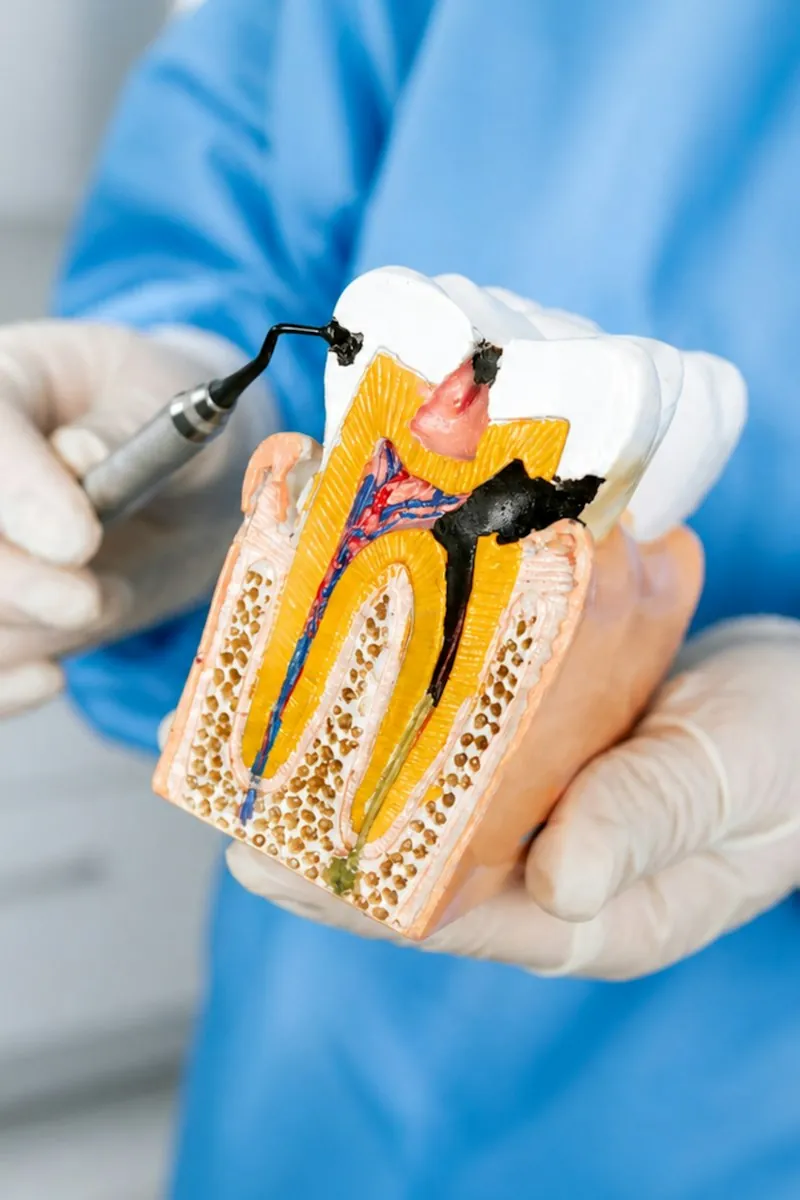
Part 3: the surface letters
A tooth has several sides. The schedule has separate filling items for one, two, three or more surfaces, so plans often add letters after the tooth number. The schedule counts a surface by its line angles and treats the biting edge of a front tooth as its own surface.
| Letter | Surface | Where it is |
|---|---|---|
| M | Mesial | The side facing the middle of the arch |
| D | Distal | The side facing away from the middle |
| O | Occlusal | The biting top of a back tooth |
| I | Incisal | The biting edge of a front tooth |
| B | Buccal | The cheek side of a back tooth |
| La | Labial | The lip side of a front tooth |
| L | Lingual | The tongue side of a lower tooth |
| P | Palatal | The roof of mouth side of an upper tooth |
So "MOD" means three surfaces: both sides that touch the next teeth, plus the top. On a back tooth that matches item 533, a three surface filling. If the letters and the item number do not match up, ask the practice to check the line.
Sources: Australian Dental Association, The Australian Schedule of Dental Services and Glossary, 13th edition, glossary entries for labial, buccal, lingual and palatal, and the note on surface descriptions. Wikipedia, Anatomical terms of location, for mesial and distal.
A worked example
Here is a short made up plan, read line by line.
- 011. A full check up. No tooth number, because it covers the whole mouth.
- 022 x 2. Two small X rays.
- 533, 46, MOD. A three surface white filling on the lower right first molar.
- 615, 26. A veneered crown on the upper left first molar.
Once you can read each part, you can compare two plans line by line, and you can see if the same tooth got a different number on each one.
Plans and quotes from overseas
A plan from another country may not use the Australian item numbers.
- It may also use the Universal system, where teeth run from 1 to 32.
- If a plan lists tooth 19, that is your lower left first molar, the tooth an Australian plan calls 36.
- Write the FDI number beside every tooth before you compare an overseas quote with a local one. The conversion table lists each pair.
Check the plan names the same teeth your own dentist named. If two plans disagree about which tooth needs work, that is a question to put to both dentists.
Questions to ask about your plan
- Which tooth is this, and can you show me on the mirror or the X ray?
- What does each item number on this line mean?
- Which surfaces are included, and why that many?
- Will my health fund need anything else to process the claim?
Your dentist is the right person to say what a tooth needs. This guide only helps you read the paper.